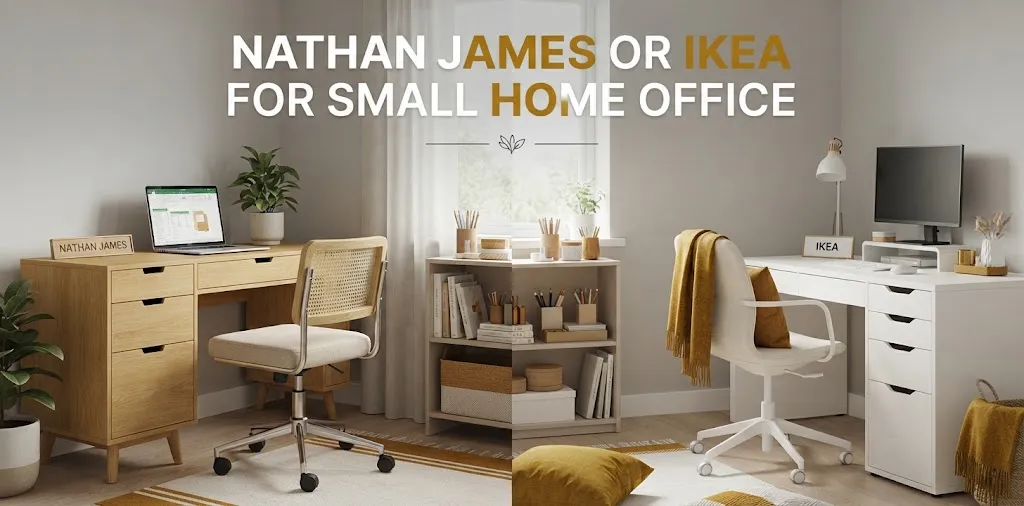
Nathan James or IKEA for a Small Home Office

For a small home office, **IKEA is usually the better choice if you want the lowest price, more size options, and flexible storage. Nathan James is the better fit if you want a more polished furniture style and prefer buying a coordinated desk or shelving piece. Your available space matters as much as your budget.
A small home office has to work harder than a large dedicated room. Your desk may need to fit into a bedroom corner, an apartment living room, or a narrow wall. You may also need storage without making the room feel crowded.
That is where the Nathan James versus IKEA decision becomes more specific than simply comparing two furniture brands.
IKEA offers a much larger selection of compact desk sizes, storage systems, and mix-and-match pieces. Nathan James has a smaller selection but puts more emphasis on furniture that looks decorative and intentional in a living space.
The Main Difference Between Nathan James and IKEA
Nathan James is generally the better choice for someone who wants their small office to look more like a finished part of their home.
IKEA is generally the better choice for someone trying to solve a space or storage problem on a tighter budget.
Nathan James focuses on styles such as mid-century modern, modern, and industrial furniture. Its desks and bookcases are designed to have a stronger furniture-like appearance, which can be useful when your workspace is visible from the rest of the room.
IKEA has a broader system-based approach. You can choose from compact desks, drawer units, shelving, wall storage, and other pieces in many different sizes. This gives you more freedom when every inch of your office area matters.
| Factor | Nathan James | IKEA |
|---|---|---|
| Small-space desk variety | More limited | Much wider selection |
| Budget options | Mid-range | Stronger low-cost options |
| Storage flexibility | Good | Excellent |
| Mix-and-match furniture | More limited | Excellent |
| Ready-to-style appearance | Strong | Varies by product |
| Best for very tight spaces | Good | Usually better |
| Home office style | More furniture-focused | More functional and customizable |
| Long-term room changes | Less flexible | Easier to reconfigure |
Choose IKEA if Space Is Your Biggest Problem
IKEA has the advantage when your office area is unusually small or awkward.
For example, a desk may need to fit into a 30-inch-wide bedroom wall, beside a bed, or inside a narrow apartment corner. IKEA’s range makes it easier to search for a piece based on exact dimensions rather than choosing from only a few desk styles.
Some compact desk options are shallow enough to work where a full-depth desk would make the room feel blocked.
IKEA also gives you more ways to build storage around the desk. You can combine a desk with:
- Drawer units
- Narrow bookcases
- Wall shelves
- Under-desk storage
- Cable management accessories
- Storage boxes and organizers
This matters in a small office because storage often creates the biggest challenge.
A large desk with no storage may look good at first but can quickly become covered with papers, chargers, notebooks, and office equipment.
A practical small-space example
Imagine you work from a one-bedroom apartment and have only one wall available in the living room.
A compact IKEA desk could be paired with vertical storage rather than a wide cabinet. This keeps more floor space open and lets the office area grow upward instead of outward.
That flexibility is one of IKEA’s strongest advantages.
Choose Nathan James if Your Office Is Part of Your Living Space
Nathan James makes more sense when your workspace is always visible.
If your desk sits in a living room, bedroom, or open-plan apartment, you may care about how it looks after the laptop is closed.
A desk with warmer wood tones, rounded details, or a mid-century design can feel more like regular furniture than office equipment. Nathan James offers several desks aimed at this type of home setup.
Its Parker writing desk, Haley desk, and other designs show the brand’s focus on combining workspace function with a more decorative look.
This can be especially useful for a small home office that cannot be hidden behind a door.
A practical small-space example
Suppose you work from a desk placed against the wall in your bedroom.
A highly functional office setup may provide excellent storage but look visually heavy in the room. A smaller Nathan James desk with a simple silhouette may take up a similar amount of physical space while creating less visual clutter.
For a room that serves several purposes, that difference can matter.
Desk Size Matters More Than Brand
Before comparing specific Nathan James or IKEA products, measure the area where the desk will go.
Check:
- Available wall width
- Desk depth
- Clearance for your chair
- Space needed to walk behind the chair
- Nearby doors and drawers
- Electrical outlet locations
A common mistake is measuring only the empty wall.
A desk might technically fit against the wall but still leave too little room to pull out the chair comfortably.
For many small offices, desk depth is just as important as desk width. A shallow desk can preserve walking space, especially in bedrooms and apartments.
IKEA has an advantage here because it offers a wider range of desk dimensions. Nathan James may be the better choice once you know that one of its available desks fits your measurements.
Storage: IKEA Has the Bigger Advantage
Storage is where IKEA is often the stronger choice for a small home office.
A compact office usually needs more than a desk. You may also need space for:
- Documents
- Printers
- Books
- Chargers and cables
- Office supplies
- Headphones
- Personal items
IKEA’s furniture system makes it easier to solve each storage problem separately.
Instead of buying one large desk with built-in storage, you can create a setup based on your actual needs. For example, you could use a narrow desk and add a small drawer unit later.
That approach is useful if you are still figuring out how much storage you really need.
Nathan James offers desks and shelving that can provide storage, but its collection is not as modular.
When Nathan James storage may be enough
You may not need a large storage system if most of your work is digital.
Someone using a laptop, monitor, keyboard, and a few basic supplies may only need a desk drawer and one nearby bookcase.
In that situation, Nathan James can provide enough storage while giving the room a more coordinated appearance.
Price: IKEA Is Usually Better for a Tight Budget
IKEA is generally the better choice when price is a major part of the decision.
The company offers compact desks at lower price points, including small models designed for limited spaces. It also gives you the option to start with a basic setup and add storage later.
Nathan James tends to sit at a higher price point for many of its home office pieces. You are often paying more for the furniture’s style and design.
That does not automatically mean IKEA offers better value.
The better value depends on what you need.
If a low-cost desk solves your space problem, IKEA may be the smarter purchase.
If you would otherwise buy a basic desk and later spend more replacing it because it does not suit your room, a better-looking Nathan James desk could make more sense.
Do not compare only the desk price
When setting your budget, include:
- Delivery
- Storage pieces
- Office chair
- Lighting
- Cable management
- Return costs or pickup arrangements
- Accessories needed to complete the workspace
A $100 desk can become a much more expensive setup after adding everything else.
Style and Appearance
This is one of the clearest differences between the brands.
Nathan James is often the stronger choice for a specific furniture style. Its home office collection includes mid-century modern, wood, industrial, and decorative designs.
IKEA offers many styles, but its main advantage is flexibility rather than a highly curated furniture look.
That creates two different buying experiences.
With Nathan James, you may find one desk that already gives you the appearance you want.
With IKEA, you may have more freedom to create your own setup by combining several pieces.
Nathan James is better for:
- Mid-century modern interiors
- Bedrooms with visible workspaces
- Living rooms with a desk in plain sight
- Buyers who want a more finished furniture appearance
- Smaller setups that do not need extensive modular storage
IKEA is better for:
- Very tight budgets
- Unusual room dimensions
- Heavy storage needs
- Renters who may change homes
- Small offices that need to grow or change
- Buyers who want more choices in desk size
Assembly and Planning
Both brands sell furniture that may require assembly, so you should consider the setup process before ordering.
The bigger difference is planning.
IKEA’s modular approach can create more planning decisions. You may need to choose the desk, storage, drawers, shelves, and accessories separately.
That can be a benefit when you have a difficult room. It lets you build around your exact space.
Nathan James may require fewer decisions if you find one desk that already fits your needs. You can choose a coordinated desk and add a matching shelf or bookcase without designing an entire furniture system.
If you dislike planning furniture combinations, Nathan James may feel simpler.
If you enjoy customizing your workspace, IKEA gives you more possibilities.
Flexibility for Renters and Future Moves
A small home office can change quickly.
You may move to another apartment, change jobs, add a second monitor, or need more storage later.
IKEA is often better for this type of changing setup because you can replace or add individual pieces.
For example, you might start with a compact desk in a studio apartment. After moving into a larger home, you could add drawers, shelving, or a larger workstation.
Nathan James works well when you are choosing a furniture piece for a specific room and want it to stay there as part of the overall design.
What About Returns and Buyer Protection?
Return policies can matter more with furniture because measurements are easy to misjudge.
Nathan James offers a 100-day return period and states that eligible returns can receive free return shipping. The company also advertises a lifetime guarantee for its products.
IKEA allows returns of new and unopened products within 365 days with proof of purchase, while open products can generally be returned within 180 days under its policy.
Policies can change, and exceptions may apply, so it is worth checking the current terms before placing a large furniture order.
Which Brand Works Better for Different Small Home Office Setups?
A bedroom office
Choose Nathan James if the desk needs to blend with bedroom furniture and remain attractive when not in use.
Choose IKEA if you need a narrow desk, extra drawers, or vertical storage.
A studio apartment
IKEA is usually the better choice because space flexibility is critical.
A smaller desk, wall storage, and compact accessories can help create a workspace without turning the whole apartment into an office.
A living room workspace
Nathan James can be a strong choice if the desk will remain highly visible.
A more furniture-like design may blend better with sofas, bookcases, and other living room pieces.
A small room with lots of paperwork
IKEA is usually the better choice because storage can be expanded more easily.
A desk alone is unlikely to solve the problem if your work requires files, supplies, and equipment.
A simple laptop workspace
Either brand can work.
The decision should come down to style, exact desk dimensions, and price.
Common Mistakes When Choosing a Small Home Office Desk
The first mistake is buying based on appearance before measuring.
A beautiful desk that is too deep can make a small room harder to use.
The second mistake is choosing the smallest desk possible.
A tiny desk saves space, but it can become frustrating if you need a monitor, laptop, keyboard, notebook, and mouse at the same time.
Another mistake is using floor space for all storage.
In a small room, vertical shelving can often be more efficient than adding another wide cabinet.
Finally, do not assume that a desk with more features is always better.
A simple desk may be the best option if you have separate storage. A larger desk with many built-in compartments may be unnecessary if it makes the room feel cramped.
Frequently Asked Questions
Is Nathan James better than IKEA for a home office?
Nathan James is better for shoppers who prioritize a polished furniture style and want their desk to blend with the rest of the home. IKEA is usually better for shoppers who need more desk sizes, storage choices, and lower-cost options.
Which brand is better for a very small office?
IKEA is usually the stronger option for a very small office because it offers more compact desks and modular storage choices. Nathan James can still work well if one of its smaller desks fits your measurements and you prefer its design.
Is IKEA or Nathan James better for a desk in a bedroom?
Nathan James may be better if the desk needs to look like part of the bedroom furniture. IKEA may be the better choice if the room has limited space and you need to carefully match the desk with storage and other pieces.
The Bottom Line
For most people building a small home office, IKEA wins on flexibility, storage options, compact sizing, and budget. It is especially useful when you are working with a difficult floor plan or trying to make a workspace fit into an apartment or small room.
Nathan James is the better choice when appearance is the priority. If your desk will sit in a bedroom or living room and needs to look like a deliberate piece of furniture, its designs may be worth the higher price.
The smartest next step is to measure your available width, depth, and chair clearance before shopping. Then decide whether your biggest problem is lack of space and storage or finding furniture that looks right in the room. That answer will usually point you toward the better brand.